Most companies that start an AI agent project never see it run in production. That's the uncomfortable pattern behind why AI agent projects fail in 2026, and it has surprisingly little to do with the technology.
Look at the gap. Roughly 75% of enterprise leaders told Forrester in June 2026 they're adopting agentic AI, yet Gartner's 2026 CIO Survey found only 17% have deployed agents, and Deloitte found just 11% have production-ready systems.
Codiantech builds AI automation and custom AI agents for clients in Europe, the UK, the USA and Saudi Arabia. Below are the seven mistakes that sink these projects, ordered from the earliest stage of a project to the last.
Why Do AI Agent Projects Fail?
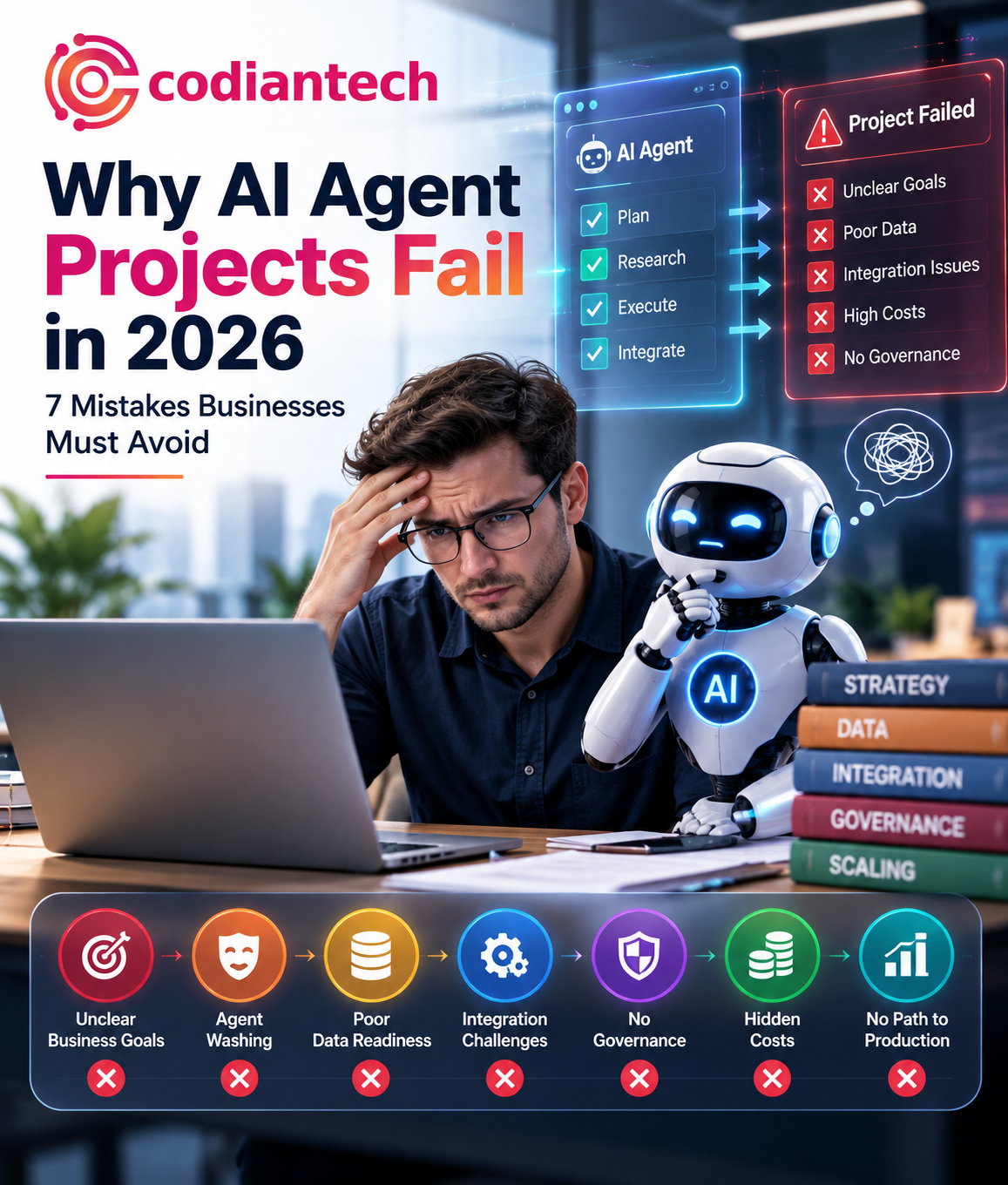
AI agent projects usually fail because of planning and management problems, not weak models. The common causes are unclear business goals, agent washing, messy data, hard-to-reach systems, missing governance, hidden costs, and pilots with no path to production. Gartner expects over 40% of agentic AI projects to be canceled by the end of 2027.
Gartner puts the blame on escalating costs and unclear business value. Risk controls that fall short finish the job.
| # | Mistake | The fix |
|---|---|---|
| 1 | Starting with technology, not a goal | One workflow, one measurable result |
| 2 | Falling for agent washing | Use the simplest tool that works |
| 3 | Ignoring data readiness | Audit the data before you build |
| 4 | Underestimating integration | Map every connected system first |
| 5 | No governance or rollback | Permissions, approvals, logs, an owner |
| 6 | Hidden costs | Budget cost per task, monitor usage |
| 7 | Treating the pilot as the finish line | Plan for production from day one |
Mistake 1: Starting with Technology Instead of a Business Goal (Why Codiantech Begins with Outcomes)
Picture the kickoff meeting. Someone says, "We need an AI agent." Nobody can say what it should improve, by how much, or compared to what.
That's the pattern behind a lot of cancellations. A Gartner analyst has described most current agentic AI projects as early experiments or proofs of concept, driven by hype and often misapplied.
Pick one workflow. Pick one number: hours per week, cost per ticket, first-response time. Write down today's value before anyone builds anything. If the agent can't beat that baseline, you'll find out in a month instead of a year, and you'll have AI agent ROI you can defend in a budget meeting.
At Codiantech, we don't start a build until the target metric fits in one sentence.
Mistake 2: Falling for Agent Washing (Codiantech's Fit Check Before We Build)
Not every problem needs an agent. Sometimes a simple workflow does the job for a tenth of the effort.
The market doesn't help. Gartner estimates only about 130 of the thousands of vendors claiming agentic capabilities deliver the real thing, and it calls the rebranding of old chatbots and RPA tools "agent washing." You can end up paying agent prices for dressed-up automation. beam
| If your task is... | You probably need... |
|---|---|
| Fixed, rule-based and repetitive | Workflow automation or RPA |
| Answering questions from your documents | A chatbot with retrieval |
| Multi-step, needs judgment, uses several tools | An AI agent |
Our view: use the dullest tool that works. Our AI and intelligent automation services begin with that exact check, and sometimes the answer is "you don't need an agent."
Mistake 3: Ignoring Data Readiness (What Codiantech Audits First)
An agent that answers customer questions from a product database will answer confidently, even when half the records are outdated. It doesn't know they're wrong. It just acts.
Agentic systems depend on continuous, clean, structured data to make autonomous decisions. And Gartner predicts that through 2026, 60% of AI projects unsupported by AI-ready data will be abandoned.
Before building, check the data the agent will touch. Look for duplicates, stale records, missing fields and sources that contradict each other. Fix the worst gaps first. Treat AI readiness as part of the project plan, because it is.
Codiantech runs this audit before any development starts.
Mistake 4: Underestimating Integration (Where Codiantech's Engineering Matters Most)
An agent that drafts a quote is a nice demo. An agent that checks stock, applies the right pricing rule and writes the order back into your ERP is a project.
That second kind needs read and write access across your CRM, ERP, helpdesk and payment tools. Projects often stall in the integration phase, consume budget without producing outputs, and get canceled before they reach ROI.
List every system the agent must connect to, and who owns each one, before you set a timeline. If your business runs on Odoo, start there. Our Odoo 20 implementation guide covers how AI fits into an ERP rollout, and our custom software development team builds the connections themselves.
We map integrations first, because that's where schedules slip.
Mistake 5: No AI Agent Governance (Codiantech's Guardrails for Safe Agents)
Picture a support agent that's allowed to issue refunds. Nobody set a limit, and nobody is watching the log. It misreads one policy and approves two hundred refunds before lunch.
As agents move toward production, governance rather than intelligence becomes the deciding constraint. Projects often fail when companies give systems access and authority before they define governance, ownership and rollback controls.
What to put in place before launch:
- Minimum permissions: the agent gets only the access it needs
- Human approval for risky actions such as refunds, payments and customer-facing messages
- Audit logs of every action
- One named owner for the agent's behavior
- A fast way to pause or roll back
Codiantech sets these guardrails up before an agent touches live data.
Mistake 6: Hidden AI Agent Costs (How Codiantech Budgets per Task)
Cost is the quiet killer. Most organizations underestimate what it takes to get agents from pilot to production, because legacy integration and process redesign stretch the timeline. Then usage bills arrive. Unmonitored token consumption and agent loops are common culprits.
So budget per completed task, not just per build. Set usage limits and alerts. Watch spending from the first week and compare it with the value of the work the agent replaces. Include maintenance, evaluation and monitoring in the number.
An agent that costs more per task than the person it replaced isn't a success, however clever it is.
Mistake 7: Treating the Pilot as the Finish Line (Codiantech's Path from Pilot to Production)
Pilots flatter you. They run on clean examples, with people nearby who forgive mistakes.
Researchers describe a capability-deployment verification gap: the agent performs correctly in controlled testing, but the business can't verify or trust it once it runs against live data at scale. One widely quoted figure from Forrester and Anaconda says 88% of AI agent pilots never reach production.
Plan for AI agents in production from the first day:
- Build a test set from real cases and score the agent against it
- Define success criteria before the pilot starts
- Roll out in stages, starting with low-risk tasks
- Monitor accuracy and cost after launch
- Give someone the job of improving the agent over time
Before You Build: A Seven-Point Check
- One workflow and one measurable outcome
- Confirmed an agent beats simpler automation
- Data audited and cleaned where it matters
- Connected systems mapped, access agreed
- Permissions, approvals, logging and rollback defined
- Cost per task estimated, usage limits set
- Production plan, owner and success criteria written down
How Codiantech Builds AI Agents That Reach Production
Most agent projects fail in the engineering around the model, so that's where we put the effort. Codiantech pairs AI automation with web, mobile, ecommerce and DevOps work, which means the integrations and deployment get the same attention as the agent itself.
Our process runs like this:
- Discovery: choose the workflow, define the outcome, record the baseline
- Fit check: decide between automation, chatbot or agent
- Data and integration audit: find the gaps early
- Guardrails: permissions, approvals, logging, rollback
- Pilot on real cases: no demo data
- Staged rollout: expand only when results hold
- Monitoring: track accuracy, cost and value
If your team needs more hands to ship faster, our staff augmentation services can add engineers.
AI Agent Projects: Codiantech FAQ
What percentage of AI agent projects fail?
Gartner predicts over 40% of agentic AI projects will be canceled by the end of 2027. That's a forecast about cancellations, not a measured failure rate, but it shows how many projects stall before they show returns.
What is agent washing?
It's when vendors rebrand chatbots, RPA tools or AI assistants as "agentic AI" without adding real autonomous, multi-step capability.
What's the difference between an AI agent and a chatbot?
A chatbot mostly answers questions. An agent plans multi-step work, uses tools and acts across your systems, which is why it needs stronger data, integration and governance.
How much does an AI agent project with Codiantech cost?
It depends on the workflow, the systems involved, the data work and usage volume. We scope cost per task as well as build cost, so nothing surprises you after launch.
Should we build custom AI agents with Codiantech or buy a ready-made tool?
Ready-made tools suit common, standard tasks. Custom AI agents make sense when your workflow, data or systems are specific to your business. We'll tell you which one fits.
How can an AI agent project succeed?
Start with one measurable goal, prepare your data, plan integrations early, set governance, budget for real costs, and design for production from the start.
Talk to Codiantech, an AI Agent Development Company That Ships
Planning an AI agent, or trying to rescue one that stalled? Talk to Codiantech. We'll help you pick the right use case, set the guardrails and get from pilot to production. Contact Codiantech


Login to comment
To post a comment, you must be logged in. Please login. Login
Comments (0)