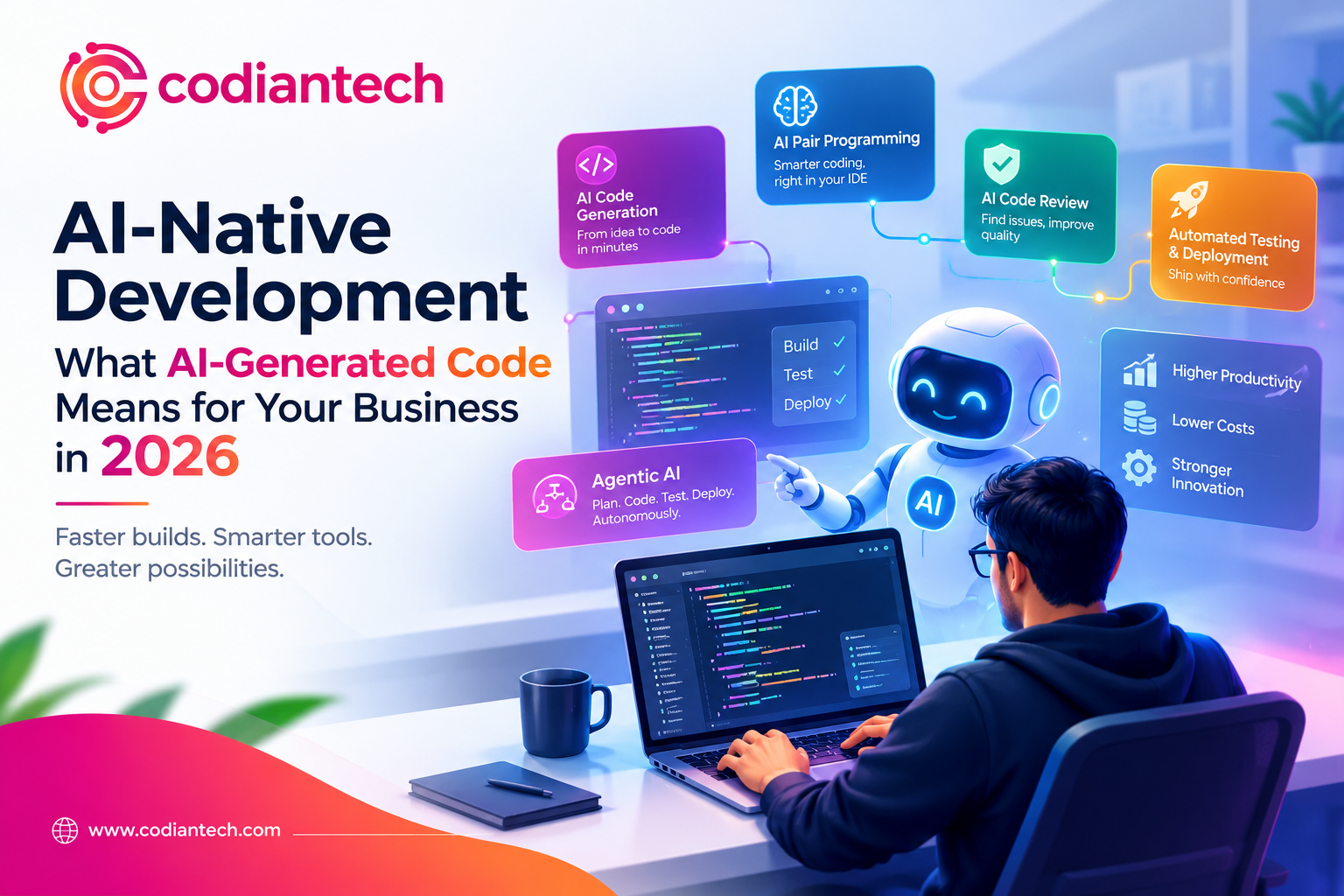
Ask a developer in 2026 how much of their code they wrote by hand, and the honest answer is usually "less than I used to." AI-native development building software where AI isn't a plugin bolted onto an existing workflow but the foundation the workflow is built around has stopped being a novelty. It's how a growing share of production software actually gets made.
That shift brings real upside: faster shipping, lower development costs, and teams that can build more with the same headcount. It also brings a problem most vendors won't say out loud a lot of AI-generated code ships without anyone fully understanding what it does or whether it will hold up in six months.
This guide, from CodianTech, covers what AI-native development actually means, why it's growing so fast, where the real risks sit, and how to adopt it without inheriting a mess you'll be paying down for years.
What Is AI-Native Development?
AI-native development describes a way of building software where AI is embedded into the core workflow architecture decisions, code generation, testing, review, and deployment rather than used occasionally as a helper tool. It's the difference between a developer occasionally asking an AI assistant for a snippet, and a workflow where AI drafts the first version of a feature, runs the tests, flags issues, and a human reviews and approves.
AI-Native vs AI-Assisted Development
The distinction matters more than it sounds. AI-assisted development is what most teams have done for the past couple of years: a developer writes code with an AI autocomplete tool running in the background, occasionally asking it to explain a function or generate a boilerplate class.
AI-native goes further. AI participates in planning, writes larger units of working code, tests its own output, and increasingly acts with a degree of autonomy orchestrating multi-step tasks across a codebase with limited human prompting at each step. That autonomous layer is usually what people mean when they talk about agentic AI in software development.
Why AI-Generated Code Is Growing So Fast
Three things are pushing this shift at once.
Developer adoption is now the norm, not the exception
The majority of professional developers already use AI tools in their daily work, or plan to start soon a trend that's moved from early-adopter territory to standard practice across the industry in under two years.
Enterprises are setting explicit AI-generation targets
Analyst projections put AI-generated code at well over half of new enterprise code by the end of 2026, a figure that would have sounded implausible three years ago and now shows up in board-level planning documents.
The tools have gotten genuinely good
Early AI coding tools produced code that needed heavy correction. The current generation handles multi-file context, understands existing architecture, and writes code that passes tests on the first or second try far more often than it used to.
Put together, these three forces mean the question for most companies isn't "should we adopt AI-native development" it's "how do we do it without creating a bigger mess than the one we're trying to solve."
The Building Blocks of AI-Native Development
AI Pair Programming and Coding Assistants
The most familiar layer: AI tools that sit inside the IDE, suggest completions, generate functions from comments, and answer questions about the codebase in real time. This is the entry point most teams start with, and it's where AI code generation first became mainstream.
Agentic AI in the Development Workflow
The layer that's changing fastest. Instead of suggesting one function at a time, agentic tools can take a ticket, plan the implementation, write the code across multiple files, run the test suite, and open a pull request with a human reviewing the result rather than writing it from scratch. This is genuinely new territory, and it's also where the most mistakes happen when teams move too fast.
AI-Native Low-Code and No-Code Platforms
A parallel trend: platforms where a plain-language description generates application logic, database schemas, and API integrations directly. These tools let non-developers build working software, which is powerful and also raises new questions about who's responsible for maintaining what gets built.
AI for Testing, Code Review, and Deployment
AI-native development doesn't stop at writing code. The same models increasingly generate test cases, flag likely bugs during code review, and monitor deployment pipelines for anomalies closing the loop from idea to production with far less manual work at each stage.
AI-Assisted vs AI-Native Development: A Quick Comparison
|
AI-Assisted Development |
AI-Native Development |
|
|
Role of AI |
Optional helper (autocomplete, Q&A) |
Embedded across planning, coding, testing, review |
|
Human involvement |
Writes most code, occasionally consults AI |
Reviews and approves AI-generated work |
|
Scope of AI output |
Single functions, snippets |
Multi-file features, sometimes full workflows |
|
Speed |
Moderate productivity gain |
Significant gain, higher review burden |
|
Risk profile |
Lower, since humans write most logic |
Higher without strong review and governance |
|
Best fit |
Teams testing AI tools cautiously |
Teams with mature review and testing practices |
Most companies don't jump straight from traditional development to fully AI-native workflows. They move through AI-assisted development first, build trust and review habits, then gradually shift more of the workflow to AI as their governance practices catch up.
Categories of Tools Powering AI-Native Development
It helps to think of the AI-native toolchain in layers rather than as one product category.
In-editor coding assistants handle real-time suggestions and inline chat, integrated directly into the developer's IDE. This is usually the first layer teams adopt, since it fits into existing habits without changing the workflow.
Agent frameworks sit a level up these take a task description or ticket and handle multi-step execution: writing code across files, running tests, and opening a pull request for review. This is the layer driving most of the productivity claims in 2026, and also the layer that needs the tightest review process.
AI-native low-code platforms target a different user entirely often non-developers who describe what they want in plain language and get working application logic, database schemas, and integrations generated for them.
AI-powered code review and security scanning tools run alongside all of the above, flagging AI-generated code for extra scrutiny, catching common anti-patterns, and checking dependencies for known vulnerabilities before anything reaches production.
The Hidden Risk: Code Quality and Technical Debt
Here's the part most AI-native development content skips.
Why AI-Generated Code Isn't Always Production-Ready
AI models generate code that runs. Running and correct aren't the same thing. A model can produce a function that passes the tests you gave it while missing an edge case you didn't think to test for, or quietly duplicating logic that already exists elsewhere in your codebase. Multiply that across a team shipping AI-generated pull requests daily, and small inconsistencies compound fast.
How Technical Debt Builds Up Silently?
The specific concern gaining the most attention among engineering leaders right now isn't a flashy new capability it's the growing, well-documented worry about the quality, maintainability, and security of AI-generated code that's already in production. Code that nobody on the team fully wrote, and therefore nobody fully understands, is harder to debug, harder to extend, and easier to break in ways that don't show up until months later.
Security Risks in AI-Generated Code
AI models can also reproduce insecure patterns they were trained on outdated authentication logic, unsafe input handling, dependencies with known vulnerabilities. Without a deliberate security review layer, AI code security risks move straight into production alongside the productivity gains.
How to Adopt AI-Native Development Without the Risk?
A workable rollout looks less like "turn on the AI tool" and more like this:
-
Start with a defined scope
Pick one team or one type of task internal tools, test generation, boilerplate features rather than switching AI-native workflows on everywhere at once.
-
Keep a human in the review loop, always
AI-generated pull requests still need a developer who understands the change, not a rubber stamp.
-
Add AI-aware code review, not just human review
Automated tools that flag AI-generated code for extra scrutiny unusual patterns, missing tests, security anti-patterns catch problems before merge.
-
Track technical debt explicitly
Treat AI-generated code the same way you'd treat a large contractor-written codebase: document it, test it thoroughly, and revisit it on a schedule.
-
Set governance before scalin
Decide who owns AI-generated code, what gets auto-approved versus manually reviewed, and how you'll audit it later before volume makes that decision for you.
-
Measure outcomes, not just output
Lines of code shipped is a vanity metric. Bug rates, review time, and production incidents tell you whether AI-native development is actually helping.
AI-Native Development Across Business Functions
Startups use AI-native workflows to build MVPs and iterate on product-market fit without hiring a full engineering team upfront speed matters more than perfect architecture at this stage, and AI-native tools are built for exactly that trade-off.
Growing SaaS companies use it to keep shipping features without linear headcount growth, while leaning more heavily on the governance and review practices above as their codebase matures and stakes rise.
Enterprises are moving more cautiously, and for good reason a security incident or an outage traced back to unreviewed AI-generated code is expensive in ways a startup's mistakes usually aren't. Enterprise adoption in 2026 is increasingly focused on reliability and governance rather than raw generation speed.
The Future: Where AI-Native Development Is Headed
A few directions are worth watching past 2026. AI governance and regulatory compliance is becoming a formal discipline of its own, not an afterthought expect more companies to have a defined policy for what AI is and isn't allowed to touch in production code. Edge AI is pushing some AI-native tooling to run on-device rather than through cloud APIs, which changes the cost and latency math for smaller teams. And the tooling gap between "AI writes code" and "AI understands why the code exists" is narrowing, as models get better at reasoning about architecture and intent rather than just pattern-matching syntax.
None of this eliminates the need for engineers who understand what's being built. It changes what they spend their time on less typing, more reviewing, architecting, and deciding what shouldn't be automated.
How CodianTech Builds AI-Native Software the Right Way?
CodianTech works with startups and growing businesses across the USA, UK, EU, and Saudi Arabia on custom software and AI-driven development and we treat AI-native workflows as a tool with guardrails, not a shortcut around good engineering.
Our approach to custom AI development services includes:
-
AI-assisted development with mandatory human review on every merge
-
Automated and manual code review focused on AI-specific failure patterns
-
Security review built into the pipeline, not bolted on afterward
-
Clear ownership and documentation for every AI-generated component
-
Architecture decisions made by engineers, with AI accelerating execution rather than replacing judgment
If you're weighing how far to push AI-native development in your own team, or you've already adopted it and want a second opinion on where the risk actually sits, talk to CodianTech.
Frequently Asked Questions About AI-Native Development
What is AI-native development?
AI-native development is an approach to building software where AI is embedded throughout the core workflow planning, code generation, testing, review, and deployment rather than used occasionally as a standalone tool.
Is AI-generated code safe to use in production?
It can be, but only with deliberate review. AI-generated code should go through the same (or stricter) review, testing, and security checks as human-written code, since models can reproduce insecure or inconsistent patterns without anyone noticing.
Will AI replace software developers?
Not in the near term. AI-native development changes what developers spend time on more reviewing, architecture, and judgment calls, less manual typing rather than removing the need for engineering expertise.
What's the difference between AI-assisted and AI-native development?
AI-assisted development uses AI as an occasional helper, like autocomplete or a chatbot for questions. AI-native development embeds AI into the full workflow, often with agentic tools completing multi-step tasks with limited human prompting.
How do I start adopting AI-native development safely?
Start with a narrow, low-risk scope, keep human review mandatory, add AI-aware code review tooling, and set governance policies before scaling usage across your whole engineering team.
Final Thoughts
AI-native development isn't a future trend to prepare for it's already how a meaningful share of software gets built in 2026. The businesses getting real value from it aren't the ones generating the most code the fastest. They're the ones treating AI-generated code with the same discipline they'd apply to any other code in production: reviewed, tested, owned, and understood.
If you want to adopt AI-native development without inheriting a technical debt problem eighteen months from now, CodianTech can help you build the workflow and the guardrails properly from the start.
Tagged with:
AI-assisted development
AI code generation
agentic AI in software development
AI pair programming
AI coding assistants
low-code AI platforms
AI code review
code quality and technical debt
AI code security risks
DevSecOps automation
AI governance in development
custom AI development services
AI software development company
enterprise AI adoption 2026



Login to comment
To post a comment, you must be logged in. Please login. Login
Comments (0)